Installation & Replacement
Package unit installation in Miami, rooftop or on the ground
A package unit holds the whole system in one cabinet outside the building. Replacing one is part HVAC job and part logistics: curb fit, crane or lift, and anchoring that survives a hurricane.
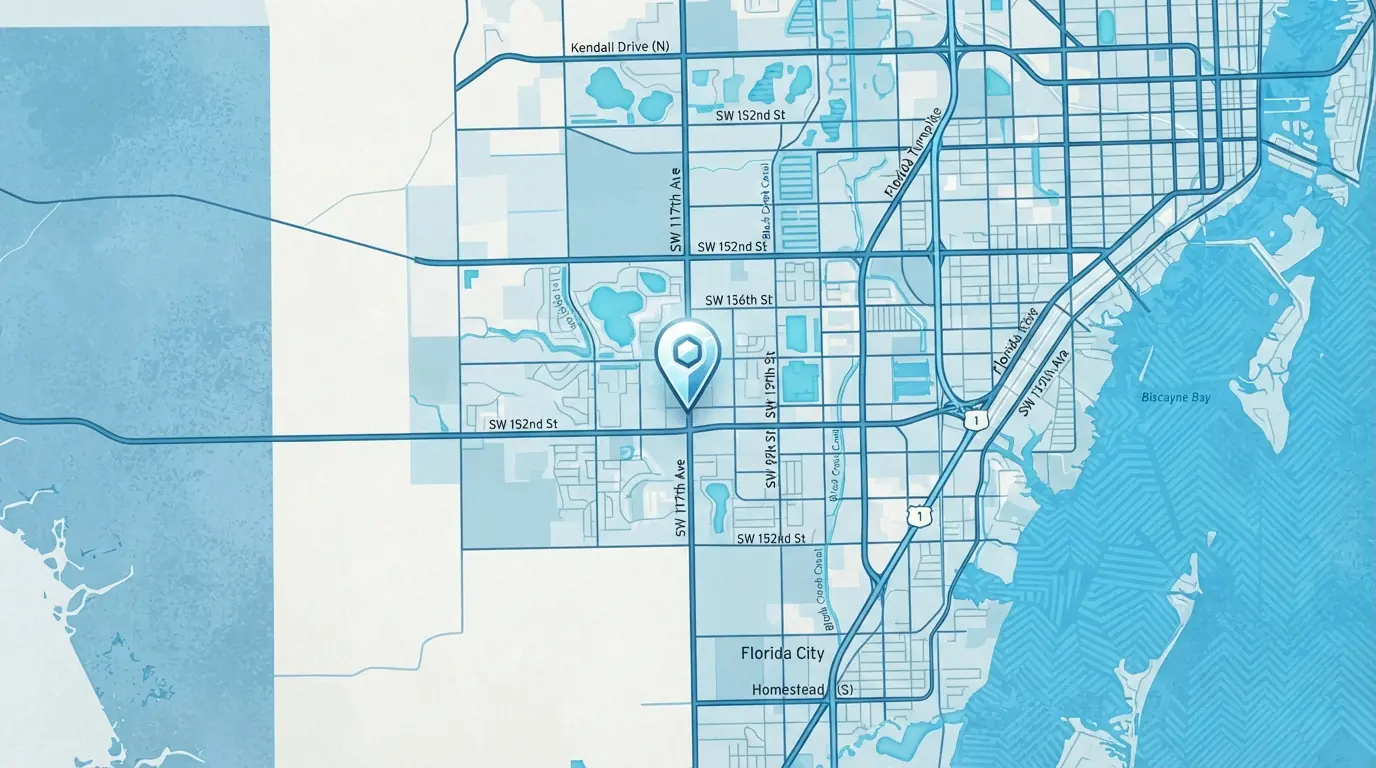
Miami service office on SW 117th Ave · We answer 24/7
- Answered 24/7
- Miami service office
- Anchored for wind code
Updated October 2026
Package unit installation in Miami replaces a single outdoor cabinet that holds the compressor, coils and blower, usually on a roof or a ground pad. Our SW 117th Ave office sizes it from a load calculation, checks whether the existing curb or pad fits the new unit, arranges the lift, pulls the Miami-Dade permit and anchors it for the county's 175 mph design wind.
The job
Why package units are their own kind of job
Package units are common on flat-roofed Miami homes, older duplexes, small commercial buildings and some mobile homes. Everything lives in one box, so there's no indoor air handler; the duct connects straight to the unit through the roof or wall.
That makes the connection the hard part. A new unit rarely matches the old one's footprint and duct openings exactly, and on a roof it has to be lifted into place, sealed against water and tied down so the wind can't peel it off the curb.
Your options
Package unit or split system
| Package unit | Split system | |
|---|---|---|
| Where it lives | One cabinet on the roof or a pad | Outdoor condenser plus indoor air handler |
| Best for | Flat roofs, no indoor equipment space | Homes with a closet or attic for the air handler |
| Replacement | One unit, crane or lift often needed | Two units, no crane in most homes |
Switching types is possible, but it changes the duct connections and needs space indoors, so we price both where it makes sense.
What moves the price
What decides the price of a package unit
Size and type
Straight cool, heat pump or gas-electric.
Rooftop or ground
Rooftop jobs need a crane or lift.
Curb fit
An adapter when the footprint changes.
Anchoring
Wind-rated hardware and engineering where required.
Duct transitions
Rebuilt and sealed at the roof or wall.
Electrical
Disconnect and breaker sized to the new unit.
Permit
Miami-Dade mechanical permit and inspection.
What we see on this job
Rooftop package units
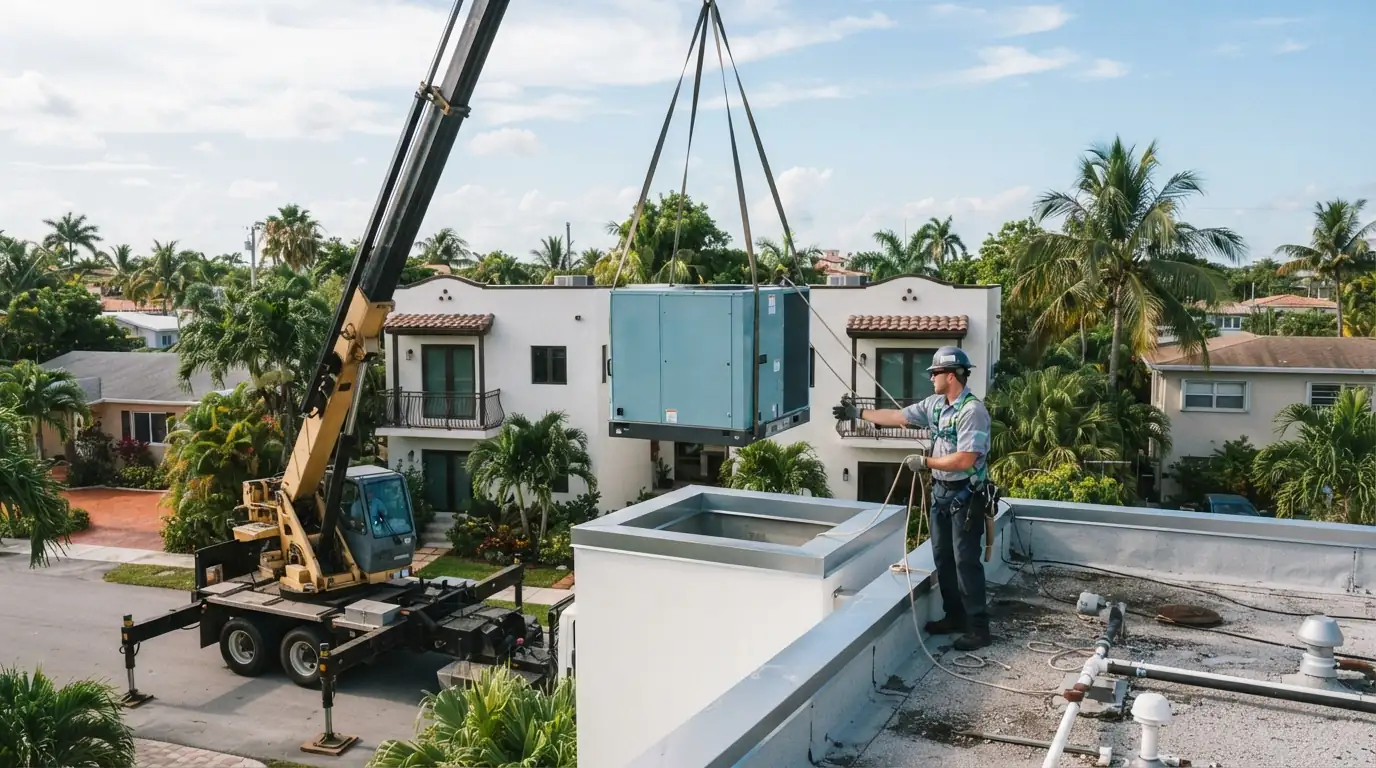
Rooftop units sit on a curb framed into the roof, with the supply and return duct dropping straight down into the building. Replacing one means disconnecting power, gas where present, the condensate line and the duct, lifting the old unit off, and setting the new one on a curb that fits it. We check the curb for rot and the roof around it for leaks before the lift, because re-roofing around a new unit is far easier than repairing it after. The crane or lift is booked for a calm morning.
Ground-mounted package units
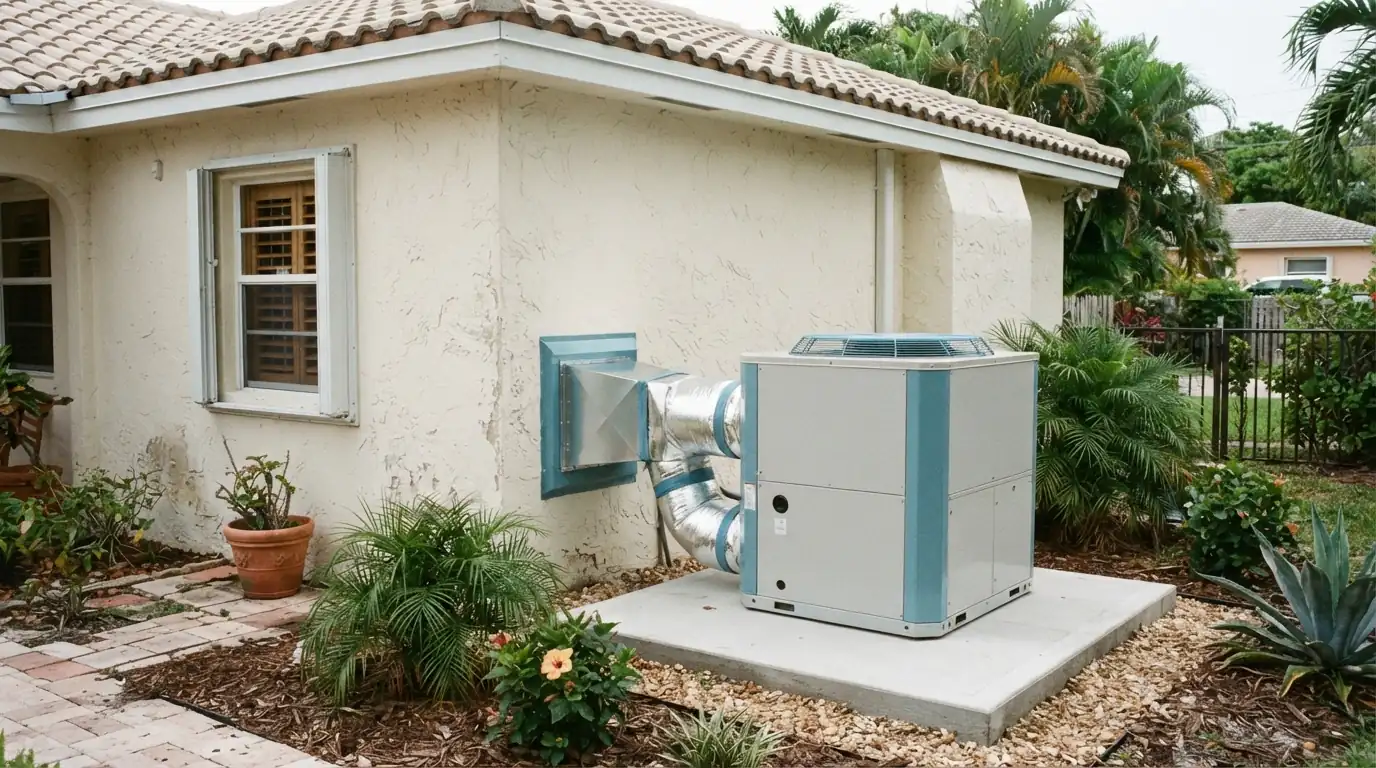
On many older homes and duplexes the package unit sits on a pad beside the house, with duct running through the wall into an attic or crawl space. The replacement is simpler to reach but has its own traps: a pad that has sunk and tilted the old unit, wall penetrations that leak air and rain, and duct transitions that were patched with tape. We level or replace the pad, rebuild and seal the wall transitions, and anchor the unit to the pad with wind-rated hardware before start-up.
Curb adapters
When a new rooftop unit's footprint and duct openings don't line up with the old curb, a curb adapter bridges the difference without cutting a new hole in the roof. It is a fabricated transition that sits on the existing curb and matches the new unit above, with insulation and seals built in. Adapters save roof work and cost, but they have to be engineered for the wind load too, so we specify one rated for the site rather than improvising a transition on the day of the lift.
Local conditions
Rooftops, storms and flooding in Miami
In Miami-Dade, rooftop mechanical units have to be anchored to resist uplift at the 175 mph design wind speed of the High-Velocity Hurricane Zone, and that anchoring is spelled out in the permit. Ground-mounted units in low coastal neighborhoods face the opposite risk, because storm surge and flooding at grade are a primary way they fail, so we look at where water stands in a heavy storm before deciding how high the new pad should sit.
Step by step
How a package unit replacement runs
- 1
Survey and load calculation
Unit, curb or pad, duct and roof checked.
- 2
Choose the unit
Size, efficiency and fuel type priced.
- 3
Permit and lift
Permit applied for; crane or lift booked.
- 4
Disconnect the old unit
Power, gas, drain and duct.
- 5
Set the new unit
On the curb, adapter or levelled pad.
- 6
Seal and anchor
Transitions sealed, tie-downs installed.
- 7
Start-up and inspection
Charge, airflow and safety checks; inspection booked.
Timing
How long a package unit replacement takes
Most ground-mounted swaps take a single day. Rooftop replacements are also a one-day job once the crane or lift is booked, with the lift itself taking under an hour. A new curb adapter or roof repair around the curb can add a day, and the county inspection follows.
Brands we service and install
FAQ
Questions Miami customers ask about package unit installation
A single outdoor cabinet holding the compressor, both coils and the blower, connected straight to the duct.
Often, but it needs an indoor air handler location and new line set; we price both.
Usually a crane or lift. We book it and schedule the swap for a calm morning.
Sometimes. When it doesn't, a wind-rated curb adapter avoids cutting the roof.
Yes. Miami-Dade requires a mechanical permit, including the anchoring details.
Most package unit swaps are a single day once the unit and lift are scheduled.
Same category
Related installation work we handle in Miami
Condo and High-Rise AC Replacement
Fan coil units, building and association approvals.
AC Zoning System Installation
Motorized dampers, zoned thermostats.
AC Unit Relocation
Moving the outdoor unit, relocating for additions and pools.
Replacing a package unit? Start with the curb and the lift
Call the Miami office to book a survey of the unit, the curb or pad and the duct connections.